6/23/25 I had a PCDF (Posterior Cervical Discectomy and Fusion) with Laminectomies, at age 40. Leading up to, and after surgery, I’ve noticed there isn’t much information online about people recovering from spinal surgeries.
90% of spinal fusions are “successful”*(*According to spine together.org), yet it seemed like the only information I could find was people having the worse experiences. I understand most people with a successful surgery move on with their lives and don’t dwell on it the same way those with more complications do, but it was frustrating to not really know what to expect. I even asked my doctors, but they didn’t have anything to refer me to.
Anxiety inducing, even. Spinal surgery is scary, terrifying, and reading through other people’s experiences normally can help in situations like this. However when I searched, I only found horror stories, regrets, people needing ongoing revisions, adjacent segment disease, people who’s partners have left them over this, broken hardware, people who are suicidal over the pain. There’s no shortage of stories like these.
Knowing what to expect can be important, it can settle your expectations, allow you to plan, but for me it wasn’t actually even entirely possible. I was scheduled to have a two level (C4-C6) ACDF, which turned into a three level C3-C6 PCDF + Laminectomies, finding out right before I went under the knife. (More about that later). So, I’ve detailed my experiences for the sake of adding to the conversation about what to expect with a major surgery and long recovery period.
I want to be honest with my experience, it’s arguably the toughest thing I’ve gone through. I’ve had a C-Section prior to this. Many eye surgeries including having parts of my retina cut out, while under local anesthesia. My spinal surgery was much worse, the time it takes to fully heal (12 months) being a huge factor. But am I grateful? Am I healing? Did this stop me from becoming paralyzed at a young age? Yes.
So, where to begin?
Prior to my surgery, I had constant pain, discomfort, for years. I use my right arm, frequently as an artist, former retail merchandiser, somewhat active person, and chocolatier. It started as an ache in my right shoulder. I painted my house, and it got worse. Then a fatigued feeling in my right arm and hand. I started lacking the ability to stick with art for any period of time. Then, typing became a challenge. (Part of this is due to carpal tunnel, but not all of it). Doing my job became a challenge. My hands started going numb for periods of time. Sometimes hours, sometimes not at all. Something felt definitely “off”.
X-rays. I got a diagnosis for minor scoliosis at age 36. Went through a round of physical therapy, where I was told when evaluated that my ribs were angled up underneath my shoulder blade, essentially stuck there in a “fixed position” and that was likely causing my pain. (I later learned the term “guarding” is where your muscles tighten around problem areas in order to protect them). PT helped, a little bit, but any sort of gentle exercise might have at that point. I learned about massage guns, ordered one. I plateaued, was kicked out of PT by my insurance. Another round of PT, insurance only covered so many visits, got kicked out. Started seeing someone outside of my insurance, paying out of pocket for any sort of relief.
The pain did not go away. I kept complaining, was sent to a pain management /back specialist, who wanted me to try a muscle relaxer. It helped slightly, but not enough. I had steroid and pain medicine injections, every few months. This helped a little, I was able to get better sleep, at least. Another round of PT. This time it seemed to only make things worse. They’d ask me how my pain was every time I came in, it was higher. I left crying many times. I eventually told them it wasn’t helping me. They referred me to “the rib specialist in the area” who did manual manipulations on me, and was actually helpful, even though my commute was long, I stuck it out. She told me I likely had what they call “slipping rib syndrome”, which reading about online, sounded plausible, although mine manifested further up my ribcage than typical SLS. Plateaued. Insurance kicked me out, again.
Sought out massage therapy. accupuncture, cupping. Lots of THC, CBD, topicals, epsom salt baths. At home cupping. Laying on heating pads, kinetic tape. accupressure (Shakti Matt) Some days were better than others, but overall I kept getting worse. My walking ability was also being limited. My hips needed constant adjustment to walk any sort of distance. I kept trying. I would get outside as often as possible. I thought I was doing the right things.
The year prior to surgery, I would walk on the Florida boardwalk, for miles with family. Walked through caves in Tennessee with friends. I kayaked, too. I kept pushing. I would do it, because nature is my therapy, and exercise matters, but I’d have to stop along the way, and a mile became too much towards my surgery.
My calves hated me. They would burn, and I felt like my legs were giving out. Eventually, when I woke up from a low blood sugar (I’m a type one diabetic since 1986) and needed to get out of a bed abruptly, (in an air bnb with a slippery floor); they did. My right leg was completely numb when I stood up, and I collapsed.
It happened again a month later, at a Marc Maron comedy show where I was sitting near the front row, and got up to use the bathroom. I had patrons tell security about me falling, left early in an ambulance, pissing myself. This is not normal when you’re 40. I started dropping things. Not being able to use my hands, whatever I had was progressing rapidly. I started having drop foot, and closer to my diagnosis, I couldn’t even hold a glass of water without spilling or dropping it.
I tried to get a referral to see someone (a rheumatologist?) for an MRI or CT scan from my PCP. He flat out refused, said there was nothing he could have done to help me. He basically told me I needed a big fancy doctor to get a referral to the big fancy hospital, either that or he could prescribe me some pills. Literally. I left crying, immediately found a new doctor.
(My therapist encouraged me to write letters to the doctors who I felt like had wronged me the most along this process- it was helpful- here’s my letter I never sent to this doctor).
Dr Klemptner,
You have no right to be practicing medicine.
I came to you, a chronic pain sufferer for over a decade, seeking answers. You dismissed me, told me sending a referral to a specialist would take months. I asked you to send it, anyway, I’ve been in pain for years. You refused.
I got the testing I was seeking done eventually by complaining to the right person, a nurse at a women’s health visit.
My MRI came back showing I have severe cervical stenosis. Myelopathy. Myeliomacia. A flattened spinal cord. Compressed nerves. Ossification of my posterior longitudinal ligament. These are progressive diagnoses, requiring priority surgery to stop the progression, hopefully before it makes me paralyzed.
What again, was your reasoning for denying me testing? You denied ordering a CT scan, and then in the next appointment denied me a referral to a rheumatologist. Either of these could have caught what is happening in my body faster than the route I was forced to take, spending hours searching for a new PCP who would simply listen.
You said a CT scan could affect kidney function. You have never monitored my kidneys to know how they function, just made assumptions based on my age, appearance, financial status. My endocrinologist says my kidneys are fine, I asked them after you denied me. Maybe educate yourself on the difference between a type one and type two diabetic.
You asked me what I was hoping to get from a CT scan. This. A diagnosis. Or in my case, several diagnoses. A medical explanation for my pain. I’m not a pill seeker and I don’t appreciate being treated like one. I just wanted an answer- what is causing all these symptoms and pain in my body?
When diagnosed with a condition like this that leads to paralysis, my understanding is that timing is important. Success rate of surgery largely depends on when symptoms were first noticed, and how quickly you act from that point on.
You did nothing but stand in my way, delay my ability to get the help I need, and shrug your shoulders casually like this is normal behavior for a doctor of medicine. Maybe you are jaded because you saw your dad’s success and he made it look easy. Come to work, flat out ignore or argue with people who need your help, collect paycheck, go home.
That’s it, it has paid off to be this lazy for you. You’re not helping people. You encouraged me to find a new PCP, because you couldn’t “do anything for me”.
You could have. You chose not to. You’re an asshole. I want you to know you are a quack. You have no right to treat people who are genuinely seeking your help this way. It’s a terrible look for a doctor.
I may still look into filing a malpractice lawsuit. I don’t have proper documentation of my visits because your staff rolled their eyes at me when I asked them to document that you were refusing to help me.
Maybe they’re used to this level of incompetence. But I’m sure as fuck not. And if I can stop one person from going through the same bullshit you put me through, great.
My ACDF surgery is in one month.
I hope you can reflect on your extreme shortcomings and question why you’re a doctor in the first place. Your office isn’t even open during business hours as is. What a joke.
If I come out of surgery and I’m still having numbness in my hands, arms, legs, lack of function, who do you think I might have to blame? Who denied me, who made this process take longer than necessary? You did. You alone. You will be the one person responsible for my disability becoming permanent, if so.
-A former patient
My pain management specialist / back doctor, would always attribute it to my minor (24%) scoliosis. She referred me to PT again, this time her specialist who took 3 months to get in with. Her specialist was amazing, assessed my whole body and determined my hips were 1” off, and started there. It made a big difference for a day or so, I would do the home exercises and go back to feeling bad, then see her again. We worked on core strength, she explained that when you have back problems you stop trusting your legs as much, so we worked on using my leg muscles, abs, and glutes more. I learned about the psoas muscle, and how tight mine always was. I attribute a little of my ability to get out of bed easily myself after surgery to her, she helped me to strengthen my muscles needed post surgery for a quicker recovery.
I had new X-rays taken after having another round of injections and stating my pain is greater than what minor scoliosis can cause, I demanded more testing. I brought my husband with me to my appointment to see if they’d listen to me any differently. I went on a low dose of Lyrica. I was so sick of the never ending pain. It was ruining my life. I don’t think this doctor ever really took my seriously. Treated me like a pill seeker, even though I refused 8 out of 10 meds she suggested over the years.
What changed? I happened to complain to the right nurse, while at an unrelated visit for chronic pelvic pain (I have PMDD & Adenomyosis- both of which I never knew existed until I was diagnosed!) when I mentioned my upper back pain. She ordered me additional testing right then, no additional hoops to jump through at all. I was shocked. Here’s a letter I wrote to my pain management/ back doctor (never sent)
Dr. Kriswari
Hello, I’ve been your patient for 3 years now. I come in every few months complaining of back pains, arm pain, shoulder pain. We’ve determined I have minor scoliosis. I’ve been in PT on and off for three years, too.
My last visit, I specifically mentioned that the pains I’m having don’t seem to line up with just having minor scoliosis. You argued saying it can affect the muscles and the rest of the body, offered another round of injections. Increased my pain meds I was so reluctant to use. I refused as I had an MRI scheduled and was hoping for some answers still, turning to injections as a last resort.
While I was being seen at a pelvic pain clinic visit (for my PMDD), I mentioned most of my pain isn’t coming from cramping, it’s coming from my back. They ordered a new set of X-rays, and I got a chance to speak with a spinal surgeon about it. She agreed that minor scoliosis might not be the true issue, based on my other symptoms, and ordered me an MRI, just based on my symptoms alone and not the X-ray, because the X-ray only showed minor scoliosis and degenerative bone disease.
My MRI was the answer I needed all along. Turns out I have severe cervical stenosis, myelopathy, a flattened spinal cord, myelomacia, compressed nerves, ossification of my posterior longitudinal ligament. My limbs have started to go numb, I have an affected gait, inability to use my hands for any length of time or for anything that requires strength. I’ve dropped glasses of water, fallen, been taken to the ER.
These conditions are progressive, no amount of PT or injections will help me with this. They said I need priority surgery. The progression of this leads to paralysis if nothing is done to intervene in a timely matter.
I’m just wondering what else I could have done to better advocate for myself while seeing you. What would have caused YOU to order an MRI? How could I have gotten these results sooner, given their progressive nature, it’s important to catch it as early as possible unless you want permanent damage. I complained to you about pain, ongoing. I’ve been in PT for years, don’t you think that would have helped if that’s all I needed? I knew something wasn’t right with my body, and it’s not the scoliosis, I’m just lucky enough to have both, and now finally the answers I’ve been seeking THIS WHOLE TIME.
While I’m hopeful that ACDF surgery will help me, I wonder if I’ve acted soon enough to prevent a permanent disability.
Is there a reason to continue seeing you? Other than the management of the scheduled pills you put me on to mask my real issues?
I want you to listen to your patients better. Give them the benefit of the doubt even if they’re young, broke, tattooed. It can help their quality of life so much, if only you gave more of a fuck or listened to their words.
It shouldn’t take theatrics and tears to make you take a patient seriously. I feel gaslighted by seeing you in a sense- oh no, it’s only scoliosis….. Plus a ton of other shit.
-A former patient
The MRI revealed I had SEVERE spinal cord compression (stenosis), irregular and problematic bony growths (Ossification of Posterior Longitudinal Ligament, or OPLL which is super rare especially for a “young” white female), compressed nerves (which cause pain) in several vertebrae, and myelopathy (tingling and weakness).
They wanted to schedule me for priority surgery, if I delayed too long it would lead to paralysis. They offered me a date the following week, but I chose to wait a month for my son to get out of school first. What a summer break. I have to give a giant shout out to my family for being so helpful and understanding during this time. My dad and step mom took my son while I was in the hospital, RV camping and kept him entertained and sufficiently hydrated in 100* heat. My husband stayed often with me at the hospital and made sure I was comfortable and as calm as could be. I wrote my son and my husband letters, in case something happened and this surgery was not successful, I wanted them to know how much they meant to me.
The surgery itself?
I arrived, a nervous mess. I cried the night before, and morning of. I wrote myself a note saying “Everything Will Go According To Plan”. When I was finally taken to the surgical prep area, I learned the plan for my surgery had changed. I’d been reading and preparing for an ACDF the whole time, but due to the extent of the OPLL which showed on my CT scan post pre-op appointment, I would need a PCDF + Laminectomies instead, and an additional fused level. This meant a much longer healing period, and a way more challenging healing time. Part of me was relieved I wouldn’t have a giant scar on the front of my neck (I’ve always had issues with people even touching my neck) but overall I was upset because I knew this would entail much more.
I have a hard time with IVs, I have small veins, so they had to put them in both of my hands. Which hurts more, but I didn’t expect them to continue to hurt, for at least two weeks, post surgery. They were bruised, badly.
When I woke up, I was happy to be awake, alive. They said the surgery went without complications. I didn’t feel strong pain, just felt out of it. Things were a bit of a blur at this point, they’d been giving me Oxy and it made me feel cloudy. A few hours after being awake, I needed more. That evening, I ate, I felt ok, sleeping was a little bit of a chore in the hospital bed, with regular nurse check ins.
I argued with the nurses constantly about the management of my type one diabetes, and I’m really glad I brought my own insulin and glucose tablets even though they advise you not to, because I used them both, a few times. It was hard to continue to advocate for myself, but I know my disease way better than they possibly could. And it was fine after I started ignoring their process 😩 If truly left up to them, I wouldn’t have left the hospital, seriously.
I was able to get up and walk a circle around the hospital floor that evening. My husband spent some time with me, and let me get some rest.
I woke up feeling ok, thinking they might let me go home that second day. I needed to get X-rays, talk with PT. Towards the end of the day, my drain was still quite full, and they decided to keep me overnight to check on it. I ended up being glad they did, because my pain flared up again really bad after walking around twice, taking X-rays. I asked for more meds even though I hated them. I was glad my husband didn’t have to manage me that night. I would have been a pain to deal with for anyone besides the medical staff.
The next morning I was hopeful. I had to get the drain taken out, get my prescriptions, and get exit paperwork. I cut my Oxy dose in half. This process of leaving took hours. The hospital was short staffed. Getting the drain taken out was the worst pain I could have imagined, I screamed. But I was so happy to be allowed to go home.
Adjusting to life at home wasn’t the easiest, getting up and out of bed was a challenge at first, but I was glad I’d been working on my core strength and abs in PT, this helped me to train my muscles to better assist me. Within 3 days I could get up myself, somewhat easily. Log roll, they say. I took 1/4 of my 5mg Oxy tablets up until my one week visit, then stopped. I hated how it made me feel. In the beginning at home when I was taking about 2.5mg, I woke up grasping for breath a few times. It really freaked me out. Slowed me down. Made me paranoid. I hate opiods. I was happy to start taking edibles instead.
Are you done healing? I would get a lot of questions from people who did not familiarize themselves with how long my healing period would actually take.
At 2.5 months out, I started experiencing nerve pain. I didn’t know why it started then, but I freaked out. The short bursts of shooting pain, burning, really scared me. What if something was off? I was walking as much as possible, as instructed. I read that some nerve pain and tingling is normal when they start to heal, but I didn’t know what to expect and if the pains I felt were “normal”.
Because initially walking is your only PT, and I was able to do so better than prior to surgery, I went on a hike on a new-to-me trail, and almost tripped on sticks several times. My thoughts would spiral into “what if I fell?” And I would dwell on it.
I went to see one of my favorite bands for the first time. I kept worrying, and for no particular reason other than my muscles hurt a lot and I was so anxious about ever having to go though anything like this ever again should something be wrong. I couldn’t stop thinking about it during the opening band (even though they were great) and I had to go outside to breathe and calm down.
There were many times something would feel “off” and my anxiety would spiral into a near panic attack over it. I had to adopt a mantra to calm myself down in these instances… “YOUR SPINE IS FINE”.
It sucks to take a full year to heal. I cried almost every day for the first 6 months, at least. It took 4-5 months to even have brief moments where it wasn’t on the forefront of my mind, like I forgot I had the surgery for a few minutes at a time. That was a cool realization.
It’s very much day by day, and sometimes without a lot of reasoning. I found myself getting upset and frustrated often.
It really feels bad, to want to do something. To see the pile of laundry, know it would make you feel better to get it done. But you stand there, intending to start. Only to have your neck seize up with pain, muscles rigid, feels like they could cut glass. You’ve already taken a muscle relaxer. A few edibles. But you have to slow down. Gentle stretches. Your back is killing you because you’ve been pushing yourself to feel normal again. You rest. But your mind won’t. You should be more capable by now, you tell yourself.
Travelled out of state by plane in December to see family. Some people commented on how I was doing, some didn’t.
Got off Lyrica in January.
Made plans to see a friend out of state in February
It’s comical the amount of PT tools I had to travel with, because I use them daily, all the time. I had to pack an entire extra suitcase for all my PT stuff.
PT packing list:
Racket ball contraption (racket ball in a pillowcase for ease of positioning)
Band for rows etc
Wedge to align spine
Electronic bone growth stimulator
(I have to wear this bulky electronic unit for 4 hours a day, for 6 months)
Cbd patches
Cbd:THC topical
Muscle relaxers
THC edibles
Cb2 hemp oil capsules
Neck pillow
At seven months out, I was working through a ton of muscle tightness still. Dysfunctional ribs. In PT, we could usually get them back in place. I can sometimes do so at home. They can go almost a day without locking up, assuming I woke up feeling ok. Sometimes I wake up with them stuck, and it takes me all day to do the right thing to make them cooperate. I learned all sorts of tricks in PT.
As of April (10 months out) some days felt pretty awesome. Some days still felt overwhelming and irritating. Sleeping through the night was a challenge. First insomnia, then “is my pillow right?” Tried different pillows (purchased two different cervical spine pillows) but there were nights where I just felt like I couldn’t stay comfortable. I feel like something needs stretching, but where? I keep doing my all my exercises and PT. I am improving. But it’s still very day by day.
Sometimes it occurs to me that I walked from one room to another without noticing my spine, or did an activity where I forgot about it for a little while.
I’m so grateful to occasionally feel “normal”. It’s rare too, but it happens. I can’t help but wonder when it will become more normal for me to feel more normal.
May, eleven months out.
Felt like I was at around 90% improvement.
Can I ever regain the 10%? Does it matter? The remaining 10% is most annoying, because I’m almost feeling great, almost.
Most days I was feeling ok. Still stiff. Lots of bones cracking (which I think is good/normal?). My shoulders are finally lowering, my guarding going away. Graduated (or maxed out my insurance coverage) from PT. Still feel like I don’t have a great range of motion.
Husband says I do a “snake dance” where I wiggle to try and adjust my spine, try to get the right part to crack or loosen up. From adding in new physical activities, my lower back starts to hurt more than my upper back.
As of May, I still have family commenting “can you move your neck like this?” And “I can tell something is wrong”, even if it’s on a good day for me.
I would be needing a wheelchair to get around if it wasn’t for this surgery. I would have lost all of my fine motor skills, all of my ability to make art, to write, to type, to function, to care for myself if I didn’t have this surgery.
I wake up thankful to only have some minor issues, now. Everyday, for years, my pain level was up around a 4. I can’t even fathom that, now, it being a 0 most of the time, just minor tightness and remaining muscle guarding, rib dysfunction, scoliosis that are bothering me instead of my spine being constricted. I can only hope it will last.
I found myself stressing about my 1 year appointment. They say that’s when you know how long term, you’ll do. If you’re awesome at 1 year, you should be awesome long term. If you’re failing to fuse and heal at one year- that’s how you can expect to be kong term.
Activities I’m proud of doing within my one year recovery period:
Walking further and more often than before surgery
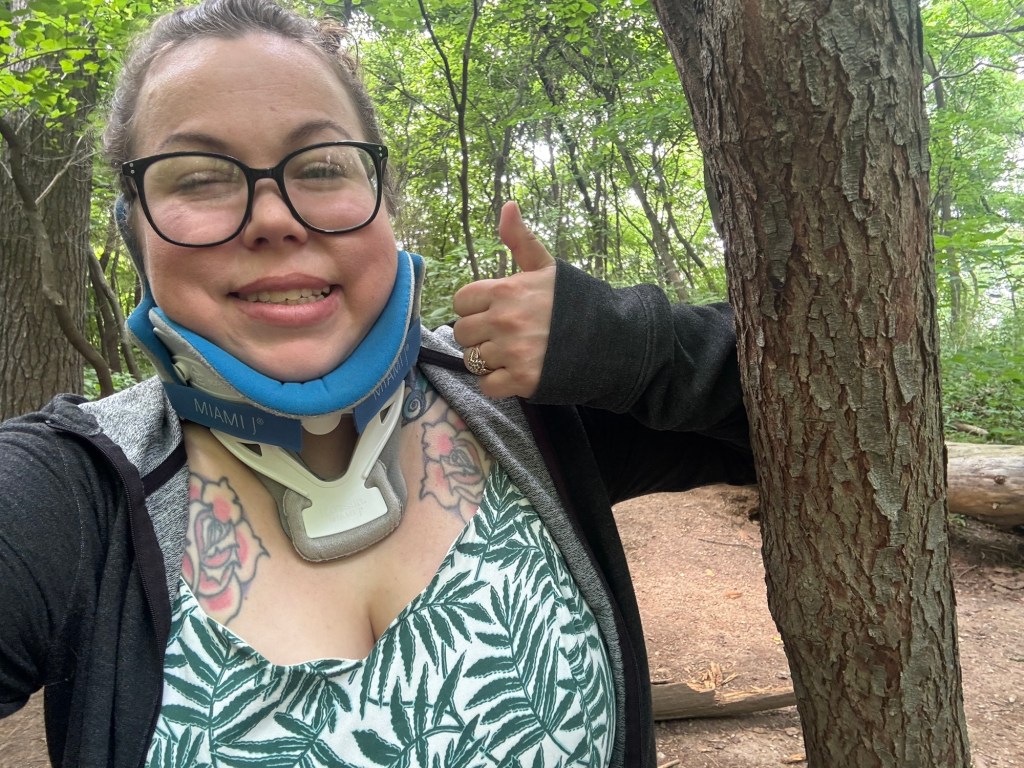
July 23rd New Bomb Turks show – with neck brace
August 15th walked around Detroit Institute of Arts Museum
August 22nd NIN show
September 6th – walked around Henry Ford Museum
September 10 Fu Manchu show
Sept 12-14 camping / fishing
Queens of the Stone Age show
Boris, Bongzilla show
Carved a stamp-a-day for a month
Flew home for holidays
Vended at a few art shows (2 exhibitions, 1 themed giveaway, and 6 artist booths!)
Flew to CA for a tattoo by myself
Spring break roadtrip – Drove from Michigan to Florida and back
Weedeater, Conan, Telekinetic Yeti show- and I felt like I could at least partially head bang at this one!
Mac Demarco show
Buying a first home
Mowed the grass
Gardening
Doing the floor – pulling up staples and helping lay tile
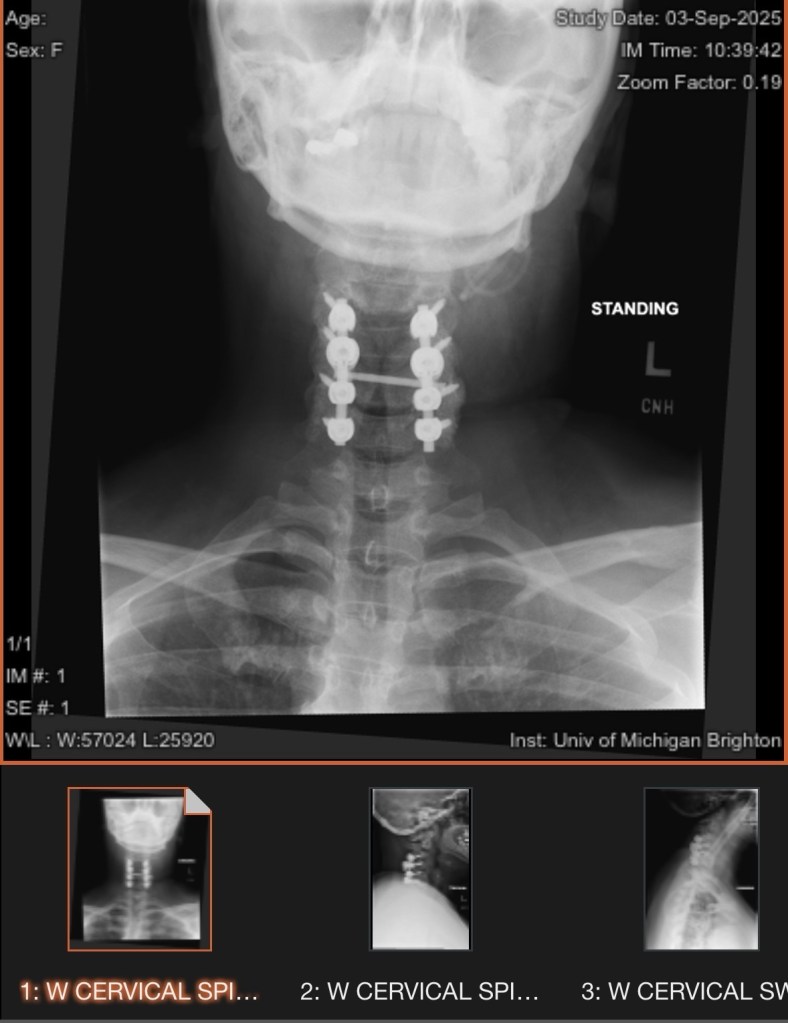
My one year appointment (today) went well. They said my hardware appears to still be in place, and there appears to be a fusion. This is really good news, it means my surgery was a success.
While I’m not quite 100%, 90% is truly a lot better than I was prior to surgery. I’m so grateful that I was finally taken seriously, and it seems, just in time to stop permanent paralysis. What will the future hold? I can’t say, but I will say I’m looking to going kayaking this weekend for the first time in over a year. For those who have read all of this, thanks for learning about my year of recovery. I hope it was enlightening or provided some hope in a terrible situation.
A man leaving the hospital today asked me how my day was going. I said it was great, that I got some really good news today. He said that’s something to be appreciated in a hospital setting, and I said yes, especially because it seemed like a year of bad news prior.
There’s something to be said for a long healing period- it helps put things in perspective to have had what is considered a “successful” surgery and come out better afterwards. I’m excited to finally get on with my life and start feeling more normal as every day passes. There are times when I am constantly reminded of my surgery. But, now that I’ve had confirmation that I’m fused, maybe I can focus on other things in the years ahead.


Leave a comment